

The right format depends on payload temperature, route length, box design and how often the shipment will be opened—not simply on whether one piece looks larger. By the end, you will be able to compare slice and block specifications, estimate the required mass, load the container safely and decide when dry ice is unsuitable for chilled food.
Key takeaways
- Choose blocks for long routes and slices for frequent box opening.
- Estimate dry ice by route time, box openings and product load.
- Separate dry ice from food and provide ventilation for carbon dioxide.
- Validate the pack with temperature readings from a trial shipment.
Choose slices or blocks based on route and loading pattern
The dry ice slices versus blocks bangalore food transport decision depends on route length and how often staff open the box, not on temperature: both remain near −78.5°C. Blocks usually last longer per kilogram because they expose less surface area to air.
| Format | Mass, dimensions and surface area | Handling and best use |
|---|---|---|
| Slices | Smaller, thinner units with lower mass per piece and more exposed surface area | Stack around cartons, fill irregular voids and adjust the load in small increments; they load quickly but break and sublimate faster |
| Blocks | Larger, heavier units with lower surface-area-to-mass ratio | Stack efficiently for fewer handling events and longer routes; specify mass and thermal duty, not piece count |
| Slices at delivery points | Easy to reach and remove individually | Useful when a shipment is opened repeatedly, but exposed pieces lose mass rapidly during each stop |
| Blocks at delivery points | Harder to access once buried in the load | Better for a quick local delivery or sealed long route; remove remaining pieces at the customer door or warehouse dock ramp with suitable handling |
For a quick local delivery, slices help distribute cooling quickly. For a long route, blocks usually provide steadier hold time per kilogram. Repeated opening favours slices only when access and incremental removal outweigh their faster loss.
“Buy dry ice slices bangalore” is not a usable specification. Ask for slice dimensions, mass tolerance, packing arrangement and the time between production and dispatch. For dry ice blocks for food transport bangalore, state required mass and thermal duty. Broken pieces, air gaps and loading delays can erase the expected advantage.
Estimate the dry ice mass instead of guessing by box size
Estimate kilograms from thermal duty and route conditions, not box volume. Use 571 kJ per kilogram as the starting energy figure: that is the heat absorbed when 1 kg of dry ice sublimates at atmospheric pressure.
1. Estimate the shipment’s heat load from food mass, starting product temperature, required holding temperature, journey duration, ambient conditions, insulation quality, door-opening frequency and the heat entering through packaging. Divide the estimated heat load by 571 kJ/kg, then add a conservative allowance for uncertainty.
2. Do not turn that division directly into an order. Heat also enters through warm food, exchanged air, wet packaging, delivery stops and repeated openings. A Bangalore vehicle making frequent stops needs a different allowance from a closed, insulated loading environment; food transport cooling Bangalore routes must be sized from the actual route pattern.
3. Run a conservative trial with the intended box, packing arrangement and route. Place temperature data loggers at both the warmest likely product location and the coldest location, then record the product temperature profile.
Air beside the dry ice is not a substitute for product data. It can remain extremely cold while a carton at the load edge warms beyond its limit.
4. Record route time, loading time, dwell time at each stop, number of box openings, ambient conditions and the desired residual dry-ice mass on arrival. Include payload mass, starting temperature and holding limit in the trial record.
Use the result to set a mass-per-route specification, then repeat the test when the box, traffic pattern or delivery window changes.
Load the box to protect food from freezing and carbon dioxide
Place dry ice above the load when warm air rising through the box is the main concern, below a heavy frozen load when bottom support improves contact, or around the load when the container design allows even distribution.
For food transport cooling Bangalore shipments, dry ice suits frozen payloads, not chilled foods held at 0–5°C; at −78.5°C, it can freeze and damage chilled products.
- Put slices or blocks in a separate compartment, under a rigid spacer, or behind a defined barrier. Never let them touch food directly.
- Use slices around cartons to reduce hot spots; use blocks with a barrier and check for local freezing or freezer burn.
- Keep dry ice away from moisture-sensitive packaging. Direct contact can weaken wet cartons, crush stacked packs, or damage flexible films as food freezes.
- Use a vented insulated container. Airtight sealing traps sublimated carbon dioxide, allowing pressure to deform or rupture the box.
A van, cold room, loading dock and receiving area all need ventilation. Carbon dioxide can accumulate below working height and displace oxygen; do not enter a poorly ventilated space without an entry procedure. OSHA’s reference levels are 5,000 ppm as an eight-hour time-weighted average and 30,000 ppm as a short-term exposure limit.
Remove remaining dry ice only in a ventilated receiving area, using insulated gloves and suitable tools. Do not leave it in a closed van or sealed cold room.
Specify packaging, transport and worker controls before dispatch
A repeatable pack uses a vented insulated container, a defined separator and minimal empty space—not an airtight seal. Pre-chill the payload, load slices or blocks around the cartons as designed, cover the dry ice with a low-temperature-rated HDPE or PP separator, and limit openings during loading and delivery.
| Format | Packing control | Best use |
|---|---|---|
| Slices | Nest closely, avoid individual wrapping and air gaps; distribute around cartons | Short routes, irregular voids, repeated access |
| Blocks | Secure with spacers, keep off food and avoid concentrated contact | Longer routes and fewer openings |
| Both | Leave a gas-escape path; never seal sublimating dry ice airtight | Every shipment |
Avoid ordinary glass, brittle PVC or untested rubber at −78.5°C. Avoid airtight plastic liners that obstruct venting, and direct contact with moisture-rich food, which causes freezing damage, freezer burn and condensation against the product. Pre-chilling the payload reduces moisture exchange; dry, low-absorption separators protect cartons.
Dry ice is UN 1845, a Class 9 dangerous good. Local road delivery still needs trained handlers, gloves, eye protection, ventilation in vans and docks, and no sealed passenger compartment. Air freight demands a venting package, dry-ice weight marking and carrier documentation under stricter airline rules.
Before dispatch, specify:
- Payload mass, product temperature, route duration, dwell time and delivery window
- Container type, expected residual mass, slice or block dimensions and packing method
- Road or air mode
Someone searching “buy dry ice slices Bangalore” or “dry ice slices Bangalore” needs those details; “dry ice blocks for food transport Bangalore” is not a piece-count specification. SK Dry Ice is useful when it confirms them rather than quoting only pieces.
Related products
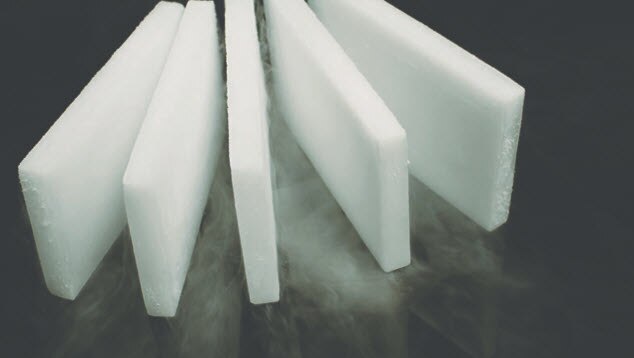 | DRY Ice In Bangalore, dry ice cubes are commonly used for cooling, food preservation, and creating special fog effects at events. View product → |
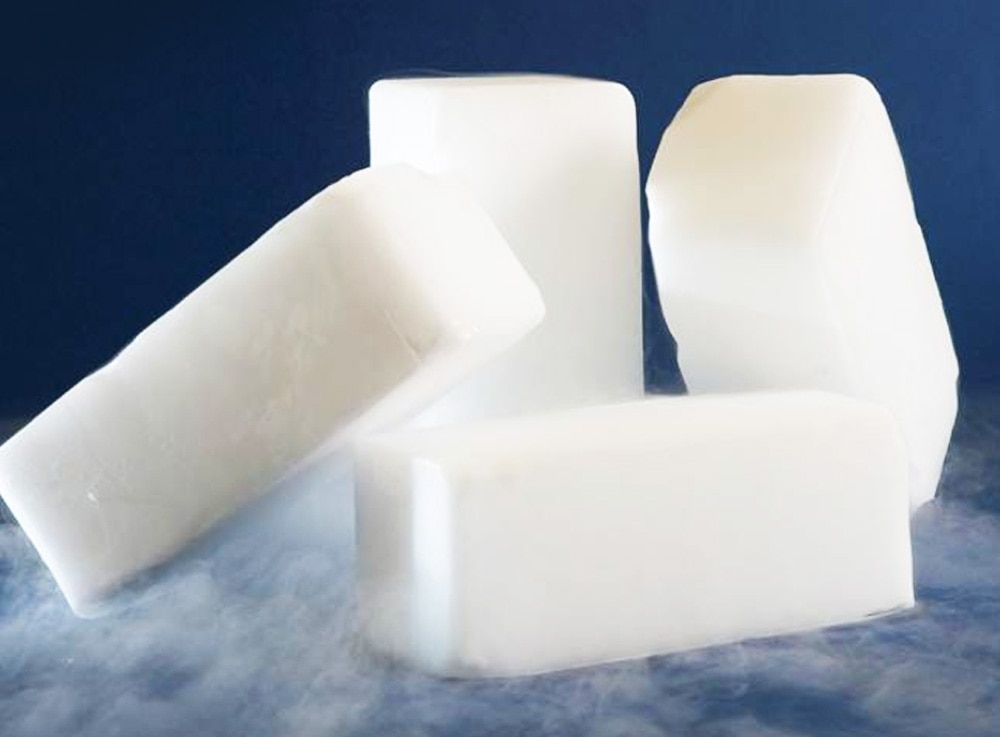 | DRY Ice Dry ice blocks are large, solid pieces of carbon dioxide used for long-lasting cooling in industries such as food preservation, medical storage, and... View product → |
Make the final choice with a trial shipment and temperature evidence
Make the final choice with a representative qualification run, not a guess based on box size. The dry ice slices versus blocks Bangalore food transport decision follows the dominant risk:
| Option | Best choice when | Main limitation |
|---|---|---|
| Blocks | Hold time and fewer handling events dominate | Less flexible distribution; local freezing if poorly separated |
| Slices | Distribution, adjustable loading and repeated access dominate | More exposed surface area and faster sublimation |
| Gel packs | Food must remain chilled near 0–5°C | Limited duration and capacity |
| Eutectic plates | Reusable, controlled chilled delivery is planned | Require correct phase-change temperature and preconditioning |
| Mechanical refrigeration | Long routes need continuous temperature control | Vehicle, power and operating cost |
Run the test on the longest route, through realistic Bangalore traffic, with the actual dwell time and number of door openings. Place temperature data loggers in warm and cold positions within the load; air temperature beside dry ice cannot prove that the food stayed within specification.
On arrival, inspect the product and record remaining dry ice, packaging condition, freezing damage, and worker exposure concerns. Turn the result into a written loading pattern and mass-per-route specification stating payload, route, container, slice or block dimensions, and residual target—not a generic order for “dry ice.”
For food transport cooling Bangalore, dry ice suits frozen payloads; use a controlled chilled system near 0–5°C rather than −78.5°C dry ice. Dry ice blasting is separate: propelled pellets or particles clean surfaces, but do not establish the food-shipping mass, cleanliness, or packaging specification.
Frequently asked questions
Should you choose dry ice slices or blocks for food transport in Bangalore?
Choose blocks for longer routes because their lower exposed surface area slows sublimation. Choose slices when staff need to open the box repeatedly or distribute cooling around several product layers.
How do you estimate the dry ice mass for a food shipment?
Base the estimate on route duration, ambient exposure, box insulation, product mass and the number of openings. Do not use box volume alone; weigh the dry ice and record shipment temperatures during a trial.
How should you load dry ice with food?
Keep dry ice separated from unpackaged food, use a suitable barrier or secondary packaging, allow carbon dioxide to vent, and prevent direct contact that could freeze or damage products.
What should you specify before dispatching a dry ice shipment?
Specify the dry ice format and mass, packaging design, loading order, delivery route, opening controls, temperature-monitoring method, ventilation instructions and worker handling procedures.